
Enterprise language choices are architecture choices. A language affects how teams model boundaries, run tests, ship containers, debug production incidents, and keep code understandable years after the original authors leave.
Java has earned its place in enterprise systems. It has a mature ecosystem, strong tooling, a large talent pool, and a long record in banks, telecoms, governments, and other critical environments. Go does not erase that history. The practical question is narrower: when you build a new cloud-native service, when does Go give your team a simpler operating model than Java?
The Problem
An enterprise service is rarely just a web endpoint. It usually includes request handlers, domain logic, repositories, background workers, tests, observability hooks, dependency management, and deployment automation. The system must also survive team rotation, changing requirements, strict compliance needs, and production load.
A typical service lifecycle looks like this:
Developer change
  |
  v
Build and unit tests
  |
  v
Container image
  |
  v
CI/CD pipeline
  |
  v
Runtime in production
  |
  v
Logs, metrics, traces, and incident response
In older enterprise environments, Java often wins by default because the organization already has Java libraries, Java developers, Java build conventions, and JVM-based operational knowledge. In newer containerized and microservice-heavy systems, the default deserves a fresh review. Startup time, image size, build speed, dependency determinism, and concurrency simplicity become daily engineering concerns, not theoretical language debates.
Where Go Changes the Shape of the Code
Go's most important difference is not syntax. It is how it keeps boundaries small.
Java uses nominal interfaces. A class must explicitly say it implements an interface. That is clear, but it also couples the implementation to the interface name. In large systems, this can lead to broad interfaces that exist because a framework, test, or parent module expects them.
Go uses structural interfaces. A type satisfies an interface automatically when it has the required methods. The interface can live next to the code that consumes it, which keeps the dependency focused on behavior rather than on a shared hierarchy.
package billing

import "context"

type Invoice struct {
    Number     string
    TotalCents int64
}

type InvoiceFinder interface {
    FindInvoice(ctx context.Context, number string) (Invoice, error)
}

type MemoryInvoiceStore struct {
    rows map[string]Invoice
}

func (s MemoryInvoiceStore) FindInvoice(ctx context.Context, number string) (Invoice, error) {
    return s.rows[number], nil
}

func RenderInvoice(ctx context.Context, finder InvoiceFinder, number string) error {
    _, err := finder.FindInvoice(ctx, number)
    return err
}
MemoryInvoiceStore does not declare that it implements InvoiceFinder. It simply has the method the consumer needs. That makes testing easier because a test can define a tiny fake with the same method. It also supports the Dependency Inversion Principle, where higher-level code depends on small abstractions instead of concrete infrastructure.
The Java version is more explicit:
public interface InvoiceFinder {
    Invoice findInvoice(String number);
}

public final class MemoryInvoiceStore implements InvoiceFinder {
    @Override
    public Invoice findInvoice(String number) {
        return lookup(number);
    }
}
This style is familiar and tool-friendly, but it requires the implementing class to name the contract. In an enterprise code base with many modules, that explicit relationship can become another point of coordination.
Build and Deployment Feedback Loops
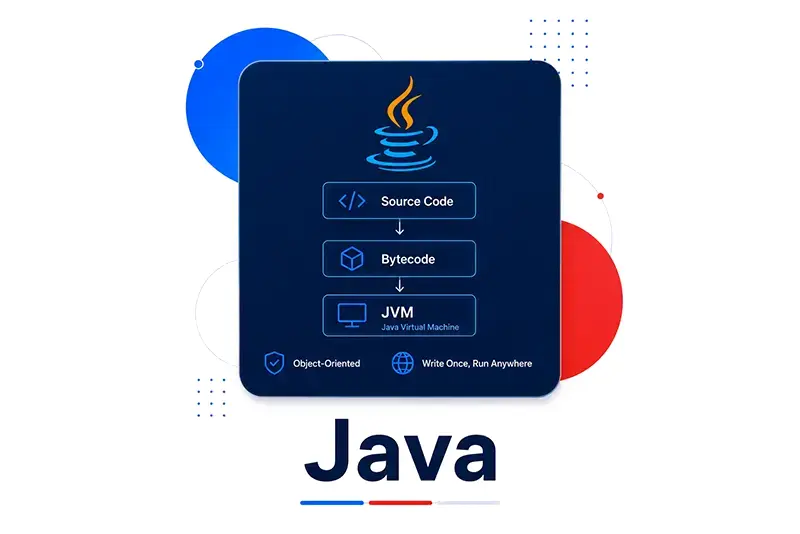
Java source code is compiled to bytecode and executed on the Java Virtual Machine, usually called the JVM. The JVM is powerful because it provides portability, runtime optimization, and mature inspection tools. It also adds an operational layer that must be started, tuned, and managed.
Java has continued improving this area. Java 25 work around ahead-of-time profiling, Project Leyden, compact object headers, and garbage collector improvements reduces some startup and runtime costs. These improvements matter, but they do not remove the basic model: Java services still run inside a JVM.
Go takes a simpler path. go build performs ahead-of-time compilation, meaning the program is compiled before it runs, into a self-contained binary. There is no classpath, no separate virtual machine to boot, and no framework-specific build script required for simple services.
A small Go service can keep its daily loop close to the standard toolchain:
go build ./...
go test ./...
go test -race ./...
go test -bench=. -benchmem ./...
For CI/CD, shorter feedback loops are not just pleasant. They reduce idle time, make failures visible earlier, and encourage developers to run tests locally before pushing changes. In a large organization, small delays multiplied across many developers become real delivery cost.
Concurrency Without a Separate Programming Model
Concurrency means structuring a program so several tasks can make progress independently. Parallelism means those tasks actually run at the same time on multiple CPU cores. Enterprise services need both: request handling, database calls, message processing, telemetry, and background work often overlap.
Java traditionally relied on operating system threads. Reactive libraries and event-driven frameworks helped with scalability, but they added new abstractions and debugging complexity. Java's virtual threads and structured concurrency are a major improvement because they make concurrent Java code more direct. They still sit on top of the JVM and depend on ecosystem support across frameworks and libraries.
Go was designed with concurrency in the language. Goroutines are lightweight units of work managed by the Go runtime. Channels let goroutines exchange values by message passing, following the Communicating Sequential Processes model, where independent tasks coordinate through communication instead of shared state.
func LoadBillingView(ctx context.Context, svc BillingService) error {
    errs := make(chan error, 3)

    go func() { errs <- svc.LoadCustomer(ctx) }()
    go func() { errs <- svc.LoadOpenInvoices(ctx) }()
    go func() { errs <- svc.LoadPaymentStatus(ctx) }()

    for i := 0; i < 3; i++ {
        if err := <-errs; err != nil {
            return err
        }
    }
    return nil
}
This example is intentionally small, but the idea scales: independent work can run concurrently without introducing a reactive framework. Go's runtime maps many goroutines onto operating system threads. In Go 1.25, the runtime is also container-aware, so the setting that controls how many OS threads execute Go code at once, GOMAXPROCS, adapts to container CPU limits.
Testing, Memory, and Dependency Discipline
Go treats testing as part of the language workflow. The standard toolchain includes unit tests, benchmarks, coverage, race detection, and fuzzing. Go 1.25 adds testing/synctest, which helps test concurrent behavior deterministically by controlling time and goroutine scheduling inside tests.
Java has a strong testing ecosystem with tools such as JUnit, Mockito, AssertJ, and Testcontainers. That maturity is valuable, but it also means teams must assemble and maintain more moving parts. Go's advantage is not that Java cannot test well. It is that Go makes a useful baseline available immediately through go test.
Memory management follows a similar pattern. Java garbage collectors such as G1, ZGC, and Shenandoah can deliver excellent results, especially when operated by teams that understand heap sizing, pause goals, and runtime diagnostics. Go favors predictability with fewer knobs. Its value-oriented design, escape analysis, and concurrent garbage collection reduce the need for constant tuning in many microservice workloads.
Dependencies are another enterprise risk. Java has improved greatly with Maven, Gradle, dependency locking, and module features, but classpath conflicts and transitive version surprises remain familiar problems. Go Modules use Minimal Version Selection and checksum files to make builds deterministic. For auditability and repeatable releases, that simplicity is a major advantage.
A Practical Decision Workflow
Use Go when the service benefits from simple deployment, fast builds, direct concurrency, and small interface boundaries. Use Java when the project depends heavily on existing JVM libraries, mature Java frameworks, or organizational standards that already work well.
A useful evaluation process is:
- Define the runtime shape. Is this a long-running JVM-friendly application, or a small service that must start quickly and scale frequently?
- List integration requirements. Check databases, message brokers, authentication, observability, and legacy systems.
- Estimate team readiness. Go is simple, but a Java team still needs to learn Go idioms instead of writing Java-style Go.
- Measure feedback loops. Compare build, test, and container deployment behavior in a small prototype.
- Review operations. Consider memory limits, startup behavior, garbage collection tuning, and production diagnostics.
- Check dependency governance. Confirm how versions, checksums, and transitive dependencies will be audited.
Common Mistakes
- Choosing Go only because it is popular, without training the team in Go's idioms.
- Writing Go as if it were Java, with unnecessary layers, large provider-owned interfaces, and excessive abstractions.
- Assuming Java is outdated. Java remains strong where JVM ecosystems, frameworks, and existing expertise are strategic assets.
- Treating goroutines like unlimited free threads. They are lightweight, not free, and they still need cancellation and lifecycle control.
- Ignoring dependency review because the build passes. Enterprise systems also need reproducibility, checksums, and auditability.
Checklist
Before choosing Go over Java for a new enterprise service, verify that:
- The service benefits from a small binary and simple container deployment.
- The team values fast build and test feedback in daily development.
- Interfaces can be kept small and consumer-owned.
- Concurrency needs can be modeled clearly with goroutines, channels, context, or standard synchronization tools.
- The operational team prefers predictable defaults over heavy runtime tuning.
- The organization can support Go code reviews, testing practices, and module governance.
- Existing JVM dependencies are not the main reason the service exists.
Conclusion
Go is a strong choice for new enterprise services when clarity, build speed, deployment simplicity, deterministic dependencies, and built-in concurrency matter more than access to a large framework ecosystem. Java remains a proven foundation for many enterprise systems, especially where the JVM platform is already central.
The best decision is not Go everywhere or Java forever. The best decision is to match the language to the architecture, the operational model, and the team that must maintain the system for years.
