
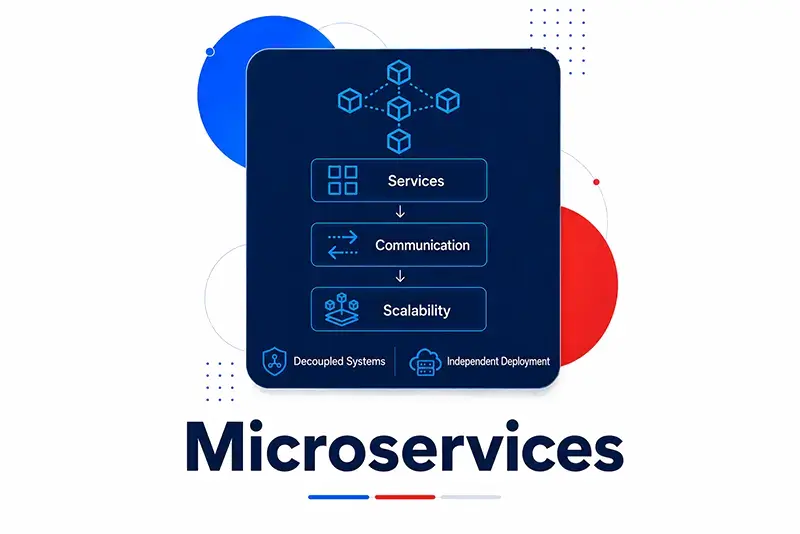
Microservices are powerful, but they are not a default answer for every Java application. A team should adopt them because the product needs the benefits, not because the architecture sounds modern.
The same is true for miniservices and serverless. Each style changes how teams build, deploy, operate, scale, and troubleshoot software. The right choice depends on release frequency, scale, consistency needs, team structure, and platform maturity.
The Problem
Microservices solve real problems, but they create real costs.
They improve independent release, replaceability, scaling, and modular ownership. They also require distributed operations, automated releases, strong observability, careful data consistency, and teams capable of owning services in production.
Benefit:
Smaller services can change and scale independently.

Cost:
The system becomes more distributed, more operationally complex, and harder to reason about globally.
A simple monolith or multi-tier application may be easier and cheaper when the product does not need frequent releases or large-scale elasticity.
When Microservices Fit
The strongest reason to choose microservices is release frequency.
If the product benefits from releasing once a week or more, and especially if it experiments with features frequently in production, microservices become more attractive. Smaller services allow teams to release selected parts without coordinating a full-platform deployment every time.
The second reason is scalability. Microservices are useful when a product must handle large numbers of concurrent users and absorb traffic peaks that are much higher than average load.
Good microservice signals:
- Frequent releases matter.
- Traffic is large or spiky.
- Different capabilities need different scaling profiles.
- Teams can own services independently.
- The platform supports automated provisioning and deployment.
Streaming services, e-commerce, and other high-traffic applications often fit this model because they need both frequent product evolution and cost-effective scaling.
When Microservices Are Overkill
Microservices may be the wrong choice when the product has fixed release windows, modest traffic, strict consistency requirements, or limited operational maturity.
Distributed data integrity is one of the biggest concerns. Traditional ACID-style transactions are easy to reason about inside a monolith, but they become hard across several processes and services. Workarounds such as idempotency, sagas, compensation, and reconciliation can work, but they must be accepted by both technical and business stakeholders.
Avoid full microservices when:
- The application does not benefit from frequent releases.
- Traffic does not require independent scaling.
- The business cannot tolerate temporary inconsistency.
- Release automation is weak.
- Environments are slow to provision.
- Teams cannot operate services as products.
A service architecture needs a DevOps-style operating model. Each microservice should be treated like a product with its own release schedule, ownership, and production responsibilities. Without that model, the architecture can become a distributed monolith with more deployment pain.
Infrastructure Readiness
Microservices require more than source code. The team needs an infrastructure model that supports fast, safe change.
Important capabilities include:
- Automated release processes.
- CI/CD pipelines.
- On-demand environment provisioning.
- Self-service deployment where possible.
- Observable logs, metrics, and traces.
- Reliable service discovery and routing.
- A platform that can scale services independently.
Kubernetes and cloud platforms can help, but the platform alone does not make the organization ready. Manual release processes and slow environment creation are strong warning signs.
Miniservices as a Compromise
Miniservices are a compromise between a monolith and strict microservices. They relax some microservice rules to reduce complexity while keeping part of the modularity benefit.
A miniservice may share a database with another miniservice. That increases coupling, so it must be evaluated carefully.
A miniservice may expose higher-level APIs that combine behavior from more than one domain model. This can reduce the need for orchestration and aggregation.
A miniservice may also share deployment infrastructure or affect the deployment of related miniservices. This is less independent than microservices, but it may be acceptable when business value matters more than architectural purity.
Monolith:
One large deployment and tightly coupled internals.

Miniservices:
Some modular boundaries, but selected shared data or deployment choices.

Microservices:
Small independently released services with strong ownership and API boundaries.
Miniservices are useful when the team wants more modular architecture but does not need the full cost of strict microservices.
Serverless and Function as a Service
Serverless shifts more responsibility to the platform. The point is not that servers disappear. The point is that developers focus more on application code and less on the underlying infrastructure.
A serverless platform can take a containerized application and handle scaling, routing, security, and other runtime responsibilities.
Function as a Service goes further. The developer writes code using a defined set of supported languages and technologies, while the platform handles the layers below the function.
A key feature is scale to zero.
No incoming requests:
Platform shuts the application or function down.

New incoming request:
Platform starts an instance and routes the request.
This can be cost-effective because resources are consumed only when needed. However, not every workload is a good fit. Applications that need long warmup time or require always-warm instances may suffer.
State is another challenge. As with microservices, serverless applications usually push state to external services. Troubleshooting and debugging can also be harder because more runtime behavior is hidden inside the platform.
The source material also warns about lock-in risk because this area has fewer mature standards than traditional Java runtimes or Kubernetes-based deployment.
Where Serverless Fits
Serverless and FaaS are rarely the best shape for a full complex enterprise application. They are often better for specific use cases.
Good candidates include:
- Batch computations.
- File format conversion.
- Glue code between larger components.
- Event-driven tasks.
- Small functions that can start quickly.
A Java team should be especially careful when startup time, debugging, state handling, and platform portability matter.
Decision Workflow
Use this workflow before choosing the architecture style:
1. Does the product need frequent releases?
   Yes -> microservices may help.
   No  -> consider monolith, n-tier, or miniservices.

2. Does traffic require independent scaling?
   Yes -> microservices or serverless may help.
   No  -> avoid unnecessary distribution.

3. Can the business accept eventual consistency in some flows?
   Yes -> distributed services are possible.
   No  -> keep strict transactions local where possible.

4. Can teams operate services as products?
   Yes -> microservices are more realistic.
   No  -> invest in DevOps and automation first.

5. Is the workload short-lived and event-driven?
   Yes -> serverless or FaaS may fit.
   No  -> a long-running service may be simpler.
The answer may be mixed. One part of the system may remain a monolith, another part may become miniservices, and selected background tasks may become serverless functions.
Common Mistakes
The first mistake is adopting microservices out of fear of missing out. If the business does not need the benefits, the complexity is usually not worth it.
The second mistake is ignoring data integrity. Distributed services often mean eventual consistency, reconciliation, and careful failure handling.
The third mistake is building microservices without DevOps. Independent services need independent ownership, automated releases, and operational feedback.
The fourth mistake is treating miniservices as a failure. They can be a practical compromise when strict microservice rules would add too much cost.
The fifth mistake is using serverless for workloads that need warm state, long startup time, or deep runtime control.
Checklist
- Release frequency justifies the architecture style.
- Traffic volume and peaks are understood.
- Data consistency requirements are explicit.
- The team can automate build, release, and environment provisioning.
- Services can be owned and operated as products.
- Miniservice compromises are documented.
- Serverless functions are small enough and stateless enough.
- Lock-in risk is considered.
- Troubleshooting strategy exists before production.
- The architecture is chosen for business value, not fashion.
Conclusion
Microservices are valuable when frequent releases, independent scaling, and modular ownership matter enough to justify distributed complexity. Miniservices are a useful compromise when a team wants modularity without every strict microservice rule. Serverless is useful for selected workloads where platform-managed scale and scale to zero provide clear value.
Choose the smallest architecture that gives the product the benefits it truly needs. Cloud-native design works best when it is pragmatic, not dogmatic.
